English| EUR
Suggested for you
More currencies
Choose a language
The Black Forest lies one border and two rail systems away from Strasbourg, connected by a sequence of regional services that thread the Rhine plain before climbing into Baden-Württemberg. This guide maps the routes, explains the transfers, and walks you through the ticketing logic for independent rail travel into the Schwarzwald.
Quick answer
Reaching the Black Forest from Strasbourg by train requires a cross-border connection via Offenburg or Freiburg, with total journey times ranging from 90 minutes to two hours depending on your final destination. Trains depart Strasbourg hourly throughout the day, connecting through Kehl on the German side of the Rhine before continuing into the forested uplands of Baden-Württemberg.
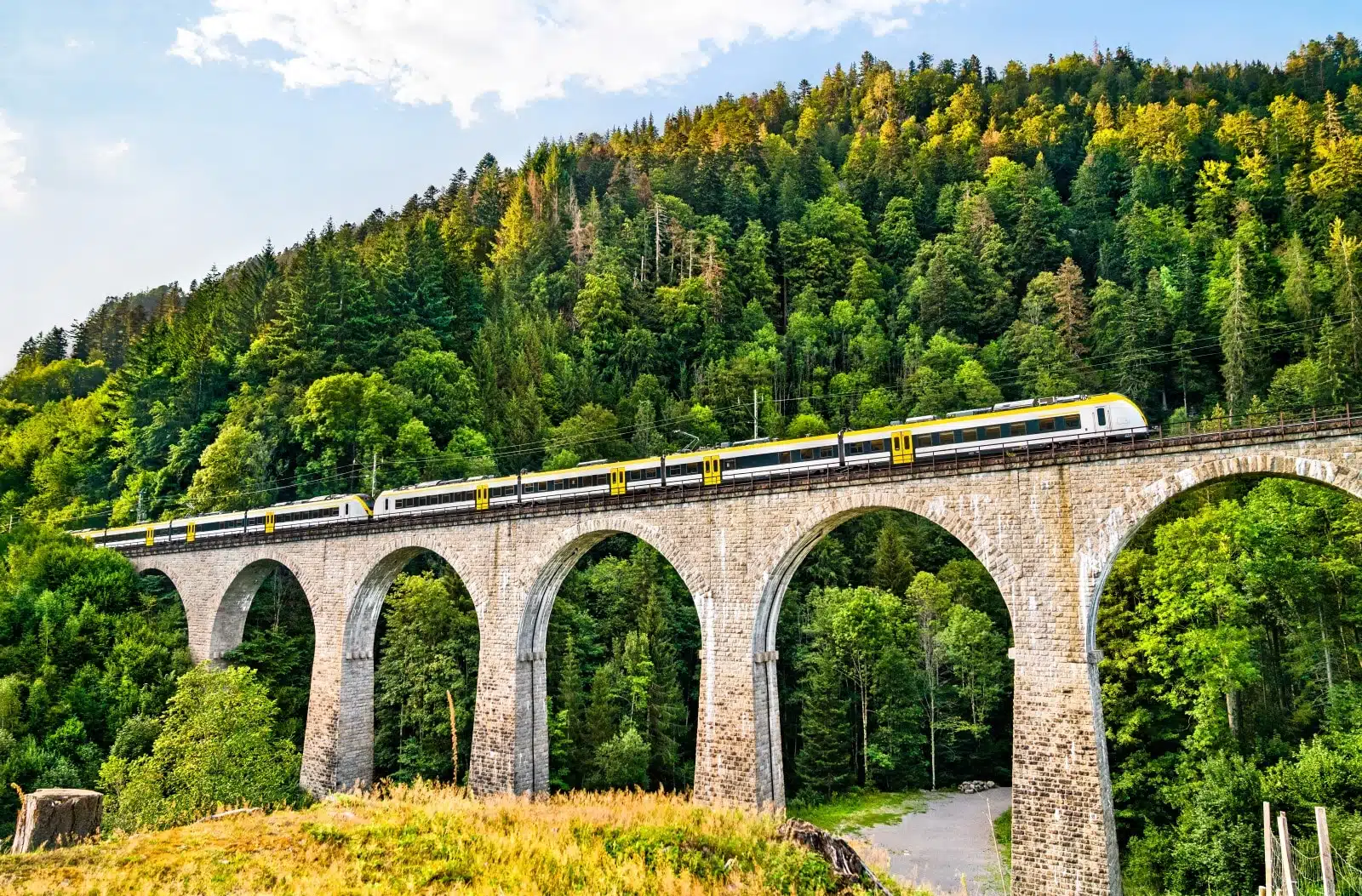
The rail corridor linking Strasbourg to the Black Forest carries no single through service. Instead, travelers navigate a handoff between French SNCF regional trains and German Deutsche Bahn connections, meeting at Offenburg or Kehl just east of the Rhine. Offenburg serves as the primary gateway: from this junction town, branch lines radiate south toward Freiburg and Titisee, east into the Kinzig Valley, and north toward Baden-Baden. Freiburg offers the most frequent onward connections into the southern Schwarzwald, while Triberg and Villingen lie deeper along the central spine. The Strasbourg-Offenburg leg runs hourly via the Rheintalstrecke, a flat, fast corridor that shadows the river's eastern bank. Journey time to Offenburg sits at 30 to 40 minutes, with most services continuing beyond into the Rhine Valley without requiring a platform change. Travelers bound for Titisee or Triberg will transfer at Offenburg onto the Höllentalbahn, a narrow-gauge line that climbs through gorges and tunnels into the high forest. The Freiburg route, by contrast, remains on the main line for an additional 20 minutes before branching onto local services. Cross-border ticketing introduces a seam: SNCF sells domestic tickets to Kehl, the first German station, while Deutsche Bahn handles onward routing into Baden-Württemberg. The Baden-Württemberg-Ticket offers unlimited regional travel within the state for a fixed daily rate, covering all connections beyond Offenburg. Purchase it at Strasbourg station before departure or via the DB Navigator app to avoid queues on the German side. Seat reservations do not exist on these regional services; boarding is open and seating follows availability. Strasbourg station sits on the western edge of the city center, reachable by tram lines A and D. Offenburg's Bahnhof occupies the town center, with onward platforms clearly signed for Schwarzwald destinations. The rail journey into the Black Forest is a logistical sequence rather than a scenic route, but the forest itself—dense, dark, and crossed by footpaths—justifies the transfer. Most travelers alight at Titisee for the lake circuit, Triberg for the waterfalls, or Freiburg as a base for deeper exploration.
“The rail corridor into the Schwarzwald carries no single through service, only a carefully timed handoff between French and German regional networks.”
The Black Forest is situated in Baden-Württemberg, Germany, and is best accessed from Strasbourg via the regional rail network. Offenburg serves as the primary gateway, connecting French regional trains to the Black Forest railway lines.
Strasbourg to Offenburg via SWEG/TER
Offenburg to Triberg via Schwarzwaldbahn
Offenburg to Freudenstadt via Ortenau-S-Bahn
Plan your journey to arrive between 09:00–11:00 to avoid mid-day crowds and maximize daylight hours for your exploration.
This procedure takes you from Strasbourg to the heart of the Black Forest in approximately two to three hours, with one transfer in Offenburg. You'll use regional trains operated by SNCF and Deutsche Bahn, both accepting standard rail passes and walk-up tickets.
Buy a cross-border ticket to Offenburg or beyond at the SNCF ticket counter, DB machines, or via the DB Navigator app. Many travelers skip reservation and use flexible regional tickets, but verify validity across the French-German border.
Departure platforms at Strasbourg change daily, so check departure boards ten minutes before your train. The TER Alsace line runs hourly to Offenburg; journey time is roughly 30 minutes.
Exit onto the main platform and follow signs for Schwarzwaldbahn services toward Konstanz, Villingen, or Donaueschingen. Trains depart every 30–60 minutes; the Schwarzwaldbahn is a scenic route threading directly into the forest.
Popular stops include Triberg (waterfall access), Titisee (lakeside village), and Freiburg (gateway town). Each station connects to local bus networks and marked hiking trails; validate any onward bus tickets immediately upon boarding.
The Black Forest region is free to enter, meaning there are no general admission charges for accessing the area. Travelers only incur costs related to their specific train tickets for the cross-border journey from Strasbourg.
Verdict: A typical adult pays 0 EUR for regional entry, with the total cost of the trip determined solely by the train fare selected.
The Black Forest region is accessible daily to accommodate travelers arriving by train from Strasbourg. Standard operating hours remain consistent throughout the week.
Everything you need to know about black forest from strasbourg by train
Travelers typically take a regional train from Strasbourg to Offenburg or Kehl to enter the Schwarzwald rail network. From there, connecting lines provide access to various towns within the region. Planning your route via regional transport websites ensures a smooth journey.
While specific ticket costs vary by destination, the regional transit system is generally affordable. You do not need to purchase expensive high-speed tickets for this local trip, as the area is well-served by regional rail connections.
The best arrival window is between 09:00 and 11:00 to avoid mid-day crowds and maximize daylight hours. Starting your black forest from strasbourg by train experience early allows for more time to explore trails and scenic towns.
Yes, the regional rail network connects to many popular villages, including those near mountain hiking paths. Local transit passes often cover these connections, making it convenient to travel without a vehicle.
Entrance to the region itself is 0 EUR, as there is no single fee to enter the Black Forest. However, individual attractions and specific museums within the region have their own varying entrance fees.
Most journeys require a transfer at a border station like Offenburg, as there are few direct lines into the heart of the forest. Using the rail network remains a reliable way to experience the local landscape.
Taking the train allows you to enjoy the scenery without navigating winding mountain roads. Rail travel is often preferred by those wanting a relaxed experience while visiting this German landmark.